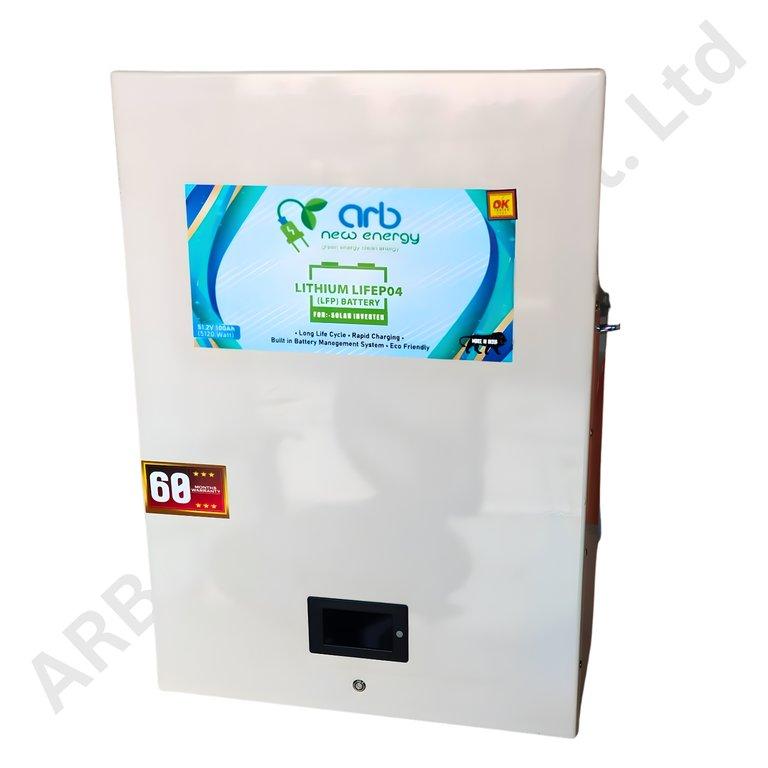
Ess Battery Pack 51.2V 314Ah Wall Mounted
Made to Order
This item is manufactured upon order. Please note that additional lead time may be required for production and delivery.
Key Feature
• LiFePO4 Energy Storage - Uses lithium iron phosphate chemistry for stationary inverter and ESS duty with stable nominal-voltage behaviour.
• 51.2V 314Ah Capacity Class - Provides approximately 16.08kWh of nominal DC energy for correctly matched backup and storage systems.
• Integrated BMS Protection - Manages cell and pack protection against abnormal charge, discharge, overcurrent and short-circuit events in stationary battery operation.
• Wall-Mounted Enclosure - The 51.2V 314Ah wall-mounted variant provides a fixed, space-efficient installation format for stationary inverter and ESS applications.
• 51.2V nominal low-voltage System Integration - Suited to inverter, solar and backup systems using charging and low-voltage settings appropriate to LiFePO4 chemistry.
₹1,55,650.00
51.2V 314Ah LiFePO4 ESS and Inverter Battery Pack Wall Mounted
The 51.2V 314Ah LiFePO4 ESS and Inverter Battery Pack Wall Mounted is a 51.2V 314Ah lithium iron phosphate energy-storage battery for stationary energy storage, inverter backup and solar-linked ESS installations. Its nominal voltage and capacity correspond to approximately 16.08kWh of stored DC energy. The pack combines LiFePO4 cells with battery-management protection so the inverter works with a complete battery assembly rather than a loose cell bank. The 51.2V voltage class, 314Ah capacity and enclosure variant are the core system-selection parameters.
This battery sits in the 51.2V nominal low-voltage power-backup family and is intended to work on the DC side of an inverter or ESS. The battery stores energy; the inverter converts that DC energy into AC output and controls the charging process. Amp-hour capacity describes stored charge, while usable backup depends on load power, inverter efficiency, permitted depth of discharge and operating temperature. LiFePO4 chemistry is used in stationary storage because it supports repeatable cycling and a stable discharge profile when operated inside its electrical limits.
The wall-mounted enclosure gives the pack a fixed vertical format that reduces floor-space demand and keeps DC connections organised. An integrated battery-management system supervises cell-group voltage and pack current and can disconnect charging or discharge paths during abnormal electrical conditions. Over-voltage, under-voltage, over-current and short-circuit protection belong to the safety layer; they are not the normal method of ending every charge or controlling every load event.
The 314Ah figure is a capacity rating, not a direct statement of safe load current. Current rises as connected power demand increases, so cable cross-section, terminal quality, protective devices and BMS current capability must be sized as one electrical path. Likewise, the calculated 16.08kWh value is nominal DC energy, not guaranteed AC energy at the socket. Inverter conversion losses, low-voltage cut-off settings, temperature and the permitted state-of-charge window determine the energy delivered to the load.
A 51.2V LiFePO4 battery is a nominal-voltage source, not a regulated 51.2V power supply. The terminal voltage moves through a defined range as the battery charges and discharges, and the connected inverter must operate inside that range. Charging voltage, charge current and low-voltage cut-off settings belong to the LiFePO4 profile rather than legacy lead-acid equalisation or desulphation routines. The battery management system protects the pack; it does not replace a correctly configured charger or inverter.
Applications
• Residential solar-storage systems where wall mounting keeps the installation compact and organised.
• Hybrid inverter installations using a dedicated low-voltage DC battery bank for daily energy shifting.
• Home and small-commercial backup systems requiring stationary storage with a fixed service position.
• Telecom, networking and control-room backup installations using compatible DC or inverter equipment.
• Off-grid solar systems where the battery stores daytime generation for evening and overnight loads.
• Engineered ESS projects combining battery, protection and inverter components within a planned installation.
Installation Guide
Isolate AC input, solar input and DC loads before installation work. Position the battery in the intended orientation, use correctly sized copper cables and properly crimped lugs, and fit suitable DC isolation and over-current protection close to the battery path. Keep positive and negative conductors clearly identified, route them away from sharp edges and heat sources, and tighten high-current connections to the hardware manufacturer’s specified torque.
Commission the system in a controlled sequence with the inverter configured for the battery’s LiFePO4 voltage class. Start with a light load, observe pack voltage, current direction, alarms and temperature behaviour, then increase the load within the designed operating range. A protection trip indicates an abnormal condition that needs investigation; repeated tripping is not a substitute for correct inverter settings, cable sizing or load management.
After commissioning, inspect cable and terminal temperature under sustained load, keep ventilation paths clear and record the inverter settings, battery identity and installation date. Parallel expansion should use batteries designed for the same electrical architecture and state-of-charge management method. Any later change to the inverter, charger, protection device, cable route or connected load should be reviewed as a system change rather than treated as a like-for-like accessory swap.
Why Choose ARB Accessories?
ARB Accessories provides ESS and inverter battery packs alongside prismatic cells, smart BMS hardware, SOC displays, busbars, cable terminals, silicone wire, fuses, breakers and battery enclosures for Indian pack builders and service teams. Prepare the enquiry around nominal voltage, Ah capacity, expected continuous and starting load, inverter or charger model and the required enclosure format so the complete battery-side specification is clear from the beginning.
Product overview
51.2V 314Ah LiFePO4 ESS and Inverter Battery Pack Wall Mounted The 51.2V 314Ah LiFePO4 ESS and Inverter Battery Pack Wall Mounted is a 51.2V 314Ah lithium iron phosphate energy-storage battery for stationary energy storage, inverter backup and solar-linked ESS installations.
- SKU
- 26001407
- Category
- Ess / Inverter Battery
- Unit
- PCS
- Minimum order
- 1 PCS
- Availability
- In Stock
Review key features and technical specifications before ordering. Contact ARB Accessories if you need compatibility or bulk-order guidance.
Datasheet
Datasheet
| Item Code | Item Name | Qty | UOM | Rate | Amount |
|---|---|---|---|---|---|
| 26000558 | JK SMART ESS BMS 8-16S 200A PB2A16S20P | 1 | PCS | ₹6,894.00 | ₹6,894.00 |
| 26001606 | Metal Box (850x425x270 mm) for ESS 314Ah 16 Cell With Wheel | 1 | PCS | ₹5,178.00 | ₹5,178.00 |
| 26001319 | SILICONE WIRE 4AWG RED | 0.75 | Meter | ₹477.00 | ₹357.75 |
| 26001318 | SILICONE WIRE 4AWG BLACK | 0.75 | Meter | ₹477.00 | ₹357.75 |
| 26000577 | JK SOC DISPLAY 3.2 INCH | 1 | PCS | ₹678.00 | ₹678.00 |
| 26002112 | EPOXY RESIN BOARD 0.8MM | 3 | KGS | ₹226.00 | ₹678.00 |
| 26001953 | Highstar LFP Cell 3.2V 314Ah Stud Weld with Packing | 16 | PCS | ₹6,300.00 | ₹1,00,800.00 |