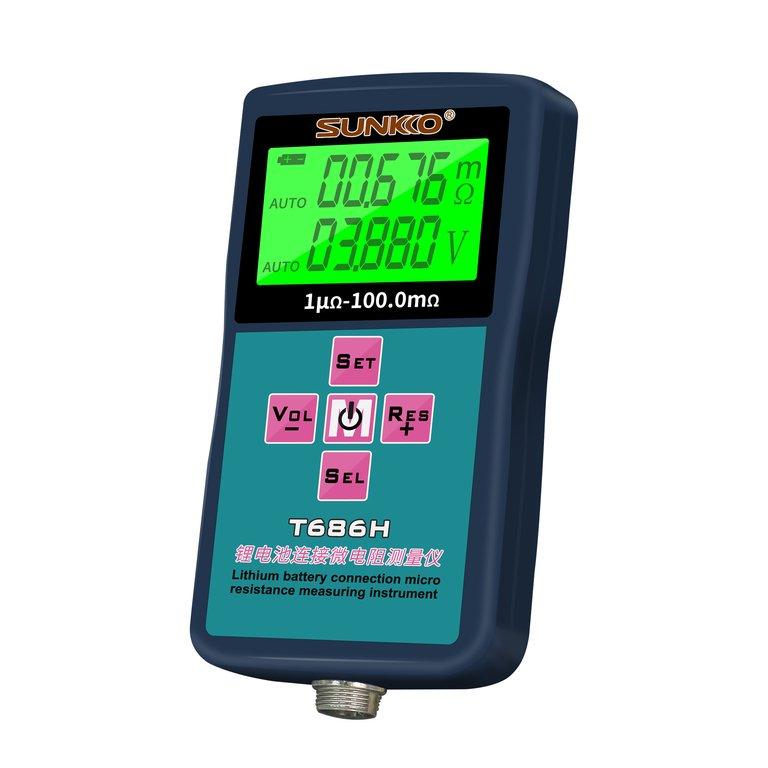
Key Feature
• Micro-Resistance Measurement - 1μΩ to 100.0mΩ range for battery evaluation.
• ±100V DC Measurement - Wide voltage window for cells and compatible battery assemblies.
• Kelvin Four-Wire Probe - Reduces lead/contact-resistance influence on low-resistance testing.
• Automatic Range Switching - Simplifies measurement across different resistance levels.
• Battery QA Instrument - Useful for cell matching, incoming inspection and workshop diagnostics.
₹13,642.00
SUNKKO INTERNAL RESISTANCE TESTER T686H
The SUNKKO INTERNAL RESISTANCE TESTER T686H is a battery test instrument intended for measurement, evaluation and quality-control work on individual battery cells and compatible battery assemblies. It is relevant to battery production lines, service workshops, cell grading, pack maintenance and R&D environments where decisions should be based on measured voltage, resistance, capacity or charge/discharge behavior rather than visual inspection alone. The exact function set depends on the model, so buyers should match the tester to the voltage range, current range, number of channels and battery format required by their workflow.
Battery test data is only useful when the measurement method is repeatable. Contact resistance at probes, clamps or fixtures can distort low-resistance readings, while incorrect current ranges or unstable connections can affect charge/discharge results. For production use, the test fixture, cable resistance, calibration interval, ambient temperature and software settings should be controlled so measurements from different batches remain comparable.
SUNKKO documentation lists model T686H with 5V charging/power input, DC voltage measurement from 0 to ±100V, internal-resistance range from 1μΩ to 100.0mΩ, ±0.5% accuracy, automatic range shifting and a Kelvin four-wire test probe. The instrument measures both AC and DC resistance references and can test at about five readings per second. These values provide the primary selection envelope for the highlighted model. For resistance or voltage testing, Kelvin or four-wire measurement should be used where the equipment provides it, because separating current-carrying and voltage-sensing paths reduces the effect of lead resistance. For charge/discharge testers, voltage and current cut-off conditions should be programmed to match the exact cell chemistry and manufacturer limits.
Testing should not be used to force an unsafe or visibly damaged battery through a cycle. Cells with swelling, leakage, severe corrosion, punctured insulation or abnormal open-circuit voltage should be quarantined according to the workshop's safety procedure. When multiple channels are available, confirm whether they are fully independent and whether each channel has its own current/voltage control before planning throughput.
Select this tester by confirming the maximum battery voltage, charge/discharge current, number of channels, supported chemistries, fixture style, communication method and required software environment. If the purpose is cell matching, define acceptance bands for voltage, internal resistance and capacity before testing begins. If the purpose is pack maintenance, confirm that the tester's maximum voltage and insulation rating are sufficient for the complete pack rather than only the individual cells.
Applications
• Battery production quality control and incoming-cell inspection.
• Capacity grading, matching and comparative performance testing where supported.
• EV, energy-storage and portable-power battery service workshops.
• R&D, prototype evaluation and long-term battery performance studies.
• Diagnostic testing before battery-pack assembly or repair decisions.
Installation Guide
Install the tester in a dry, ventilated area with the specified AC supply and protective earth. Use only correctly rated probes, clamps and fixtures. Verify polarity before connection and start with conservative current settings. Configure voltage and current limits for the battery chemistry before beginning an automated cycle. Monitor temperature during high-current testing and keep combustible materials away from the test area. Save test data with clear sample identification so results can be traced back to the correct cell or pack batch.
Why Choose ARB Accessories?
ARB Accessories focuses on lithium-battery, EV, energy-storage and battery-pack assembly components. The catalog brings together BMS boards, connectors, insulation materials, battery wiring, terminals, fuses, enclosures, testing equipment and assembly tools. For battery builders, repair workshops and OEM buyers, sourcing related components from one specialist catalog can make specification matching and procurement easier. Final suitability should still be checked against the exact battery design, equipment model and electrical requirements before installation.
Product overview
SUNKKO INTERNAL RESISTANCE TESTER T686H The SUNKKO INTERNAL RESISTANCE TESTER T686H is a battery test instrument intended for measurement, evaluation and quality-control work on individual battery cells and compatible battery assemblies.
- SKU
- 26000663
- Category
- Testing Machine
- Brand
- Sunkko
- Unit
- PCS
- Minimum order
- 1 PCS
- Availability
- In Stock
Review key features and technical specifications before ordering. Contact ARB Accessories if you need compatibility or bulk-order guidance.
Datasheet
Datasheet