Key Feature
• Multi-Chemistry ESS Control - Supports 8-16S LiFePO4, NMC and LTO battery configurations for stationary smart-energy applications.
• 100A Current-Class Design - Provides a 100A maximum-current platform for inverter batteries and scalable energy-storage systems.
• 1A Active Cell Balancing - Transfers energy between cell groups to control voltage spread during normal battery operation.
• PB1A16S10P Smart Hardware - Integrates RS232, RS485, parallel RS485, CAN, Bluetooth and a 3.2-inch colour LCD interface.
• 8-16S ESS Integration - Supports solar, inverter and backup battery systems with charge-current limiting and parallel storage architecture.
₹4,905.00
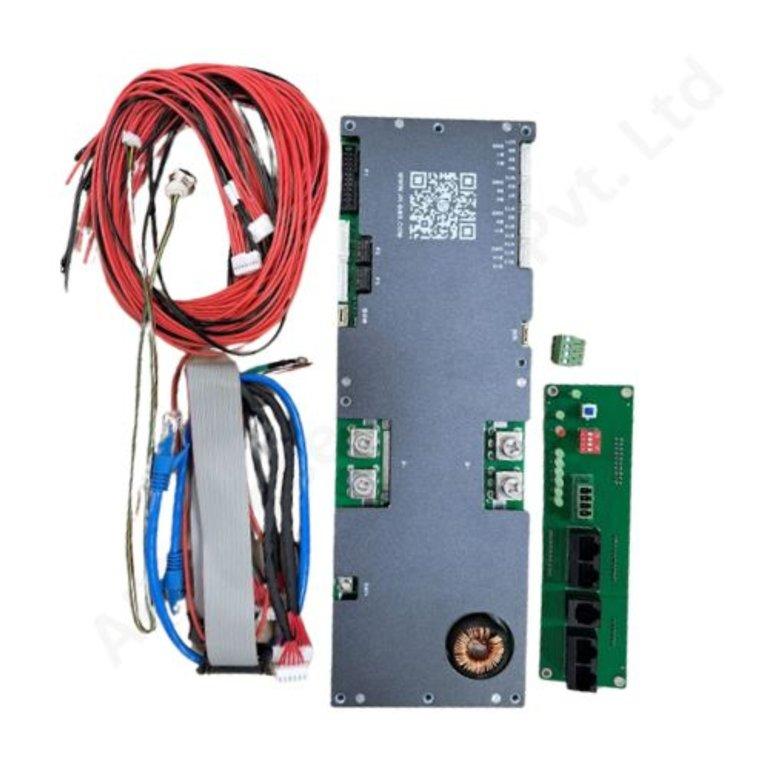
JK SMART ESS BMS 8-16S 100A PB1A16S10P
The JK SMART ESS BMS 8-16S 100A PB1A16S10P is a JK smart energy-storage BMS built around the PB1A16S10P platform for 8-16S lithium battery systems and a 100A maximum-current configuration. JK documents this inverter-BMS family for LiFePO4, ternary lithium and lithium-titanate settings with configurable cell count. It monitors series cell groups, controls the main battery current path and exchanges operating information with the ESS.
The PB1A16S10P designation identifies the electrical configuration more precisely than a generic 48V BMS label. The board supports up to sixteen series groups, while the active cell count and chemistry are configured for the finished pack. The 100A value refers to the selected discharge-current class; battery amp-hour capacity is a separate design quantity.
This model combines 1A active balancing with RS232, RS485, parallel RS485 and CAN interfaces, Bluetooth app connectivity, a 3.2-inch colour LCD and a 10A charge-current limiting function. Active balancing transfers charge between cell groups to reduce voltage spread. The communication layer supports inverter integration and service access, while dry contacts and indicators provide system-state outputs. Protection covers cell over-voltage, cell under-voltage, discharge over-current, short circuit and temperature conditions.
Active balancing is useful near the ends of the operating voltage range, but it is not a substitute for cell grading. A weak group can still reach a protection threshold early even when other groups remain healthy. 1a active balancing manages normal divergence; it cannot restore lost capacity or correct a loose busbar. The BMS measures battery behaviour, while enclosure design, conductor resistance and cell quality determine the heat and imbalance the system creates.
An 8-16S ESS battery can span several voltage classes, and the inverter must match the completed series count and chemistry rather than relying on a nominal label alone. CAN or RS485 can coordinate battery information with a compatible inverter, but protocol selection is separate from the physical bus. At 100A, conductors, terminals, fuse or breaker and busbars belong to the same engineered current path. Parallel operation also needs cable symmetry and pack addressing. The reported state of charge also depends on accurate current measurement and capacity settings, so commissioning should establish correct current direction and realistic pack capacity before the system is placed into service.
Applications
• Residential LiFePO4 solar-storage batteries using active balancing and inverter communication.
• Home ESS cabinets built from configurable 8S–16S modules with LCD and app monitoring.
• 100A-class inverter and backup batteries requiring managed high-current protection.
• Off-grid and hybrid solar systems exchanging battery information over CAN or RS485.
• Expandable parallel battery banks using addressed pack communication.
• Battery assembly and service workshops building configurable smart storage packs.
Installation Guide
Set the intended chemistry and series count around the completed cell stack. With chargers and loads isolated, map each cell-group voltage and install the sampling harness in the correct sequence. Use insulated tools, secure main current terminals, mount the display and interface board without stressing connectors, and route RS485/CAN wiring separately from high-current cables.
Start commissioning with controlled charge and discharge current. Check the LCD and app for cell voltage, total voltage, current direction, temperatures, alarms and balancing behaviour. Establish inverter communication before increasing the load. At 100A, measure terminal temperature and voltage drop through the high-current path; abnormal heating indicates a connection or conductor problem.
Record the JK model, hardware and firmware version, chemistry, active series count, balance settings, inverter protocol, address selection and commissioning measurements. Repeat thermal assessment in the final enclosure because airflow and mounting change power-device temperature. Changes to cells, pack voltage, inverter firmware, parallel-bank size or cable layout become a new electrical configuration.
Why Choose ARB Accessories?
ARB Accessories provides JK ESS BMS models with lithium cells, SOC displays, battery boxes, busbars, fuses, breakers, silicone wire, cable terminals and ESS connectors for Indian pack builders. Prepare the enquiry with chemistry, series count, continuous current, balancing current and inverter protocol so the PB1A16S10P configuration fits the complete energy-storage design.
Product overview
JK SMART ESS BMS 8-16S 100A PB1A16S10P The JK SMART ESS BMS 8-16S 100A PB1A16S10P is a JK smart energy-storage BMS built around the PB1A16S10P platform for 8-16S lithium battery systems and a 100A maximum-current configuration.
- SKU
- 26000556
- Category
- ESS BMS
- Brand
- JKBMS
- Unit
- PCS
- Minimum order
- 1 PCS
- Availability
- In Stock
Review key features and technical specifications before ordering. Contact ARB Accessories if you need compatibility or bulk-order guidance.