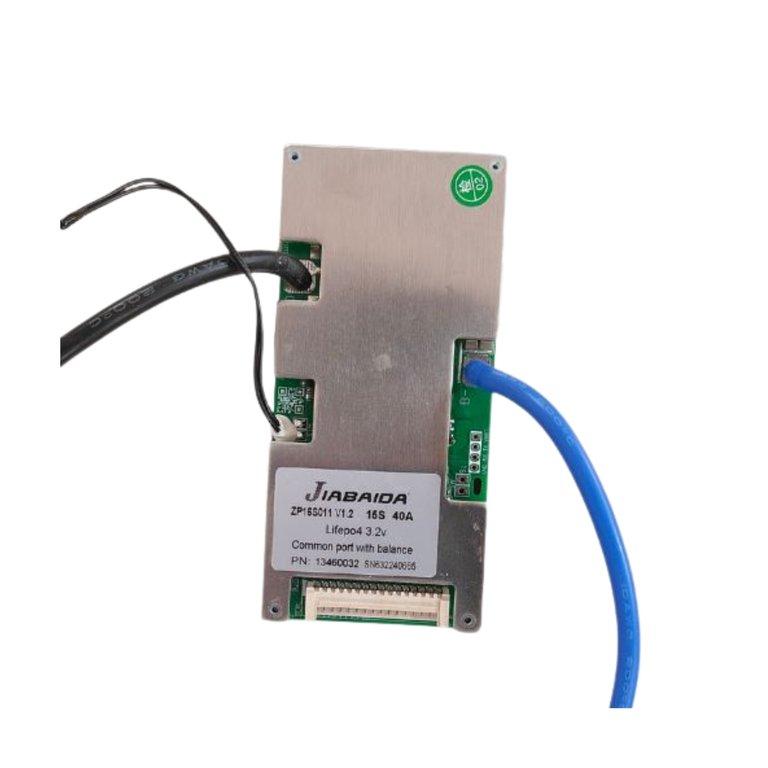
Key Feature
• 15S LiFePO4 Configuration - Correct series architecture for compatible LFP packs.
• 40A Current Variant - Practical current class for medium-power battery systems.
• ZP16S011 Hardware Platform - Documented JBD 12-16S BMS family.
• Balance & Temperature Monitoring - Model family supports cell balancing and NTC sensing.
• Common-Port Battery Protection - Straightforward charge/discharge integration.
₹688.00
JBD LFP BMS 15S 40A ZP16S011
The JBD LFP BMS 15S 40A ZP16S011 is a hardware battery-management system for 15S LiFePO4 (LFP) lithium battery packs. Model ZP16S011 identifies the hardware family where supplied. It is intended for battery builders, EV service teams, inverter and energy-storage integrators, and repair workshops that need a protection board matched to the correct chemistry, series count and load requirement. Buyers commonly search for JBD 15S 40A LiFePO4 (LFP) BMS, lithium battery protection board, 15S battery BMS and EV battery management system; the first selection check should always be chemistry and series configuration rather than physical size alone.
A BMS supervises individual cell-group voltages and the main charge/discharge path so the battery pack can be isolated when operating limits are exceeded. It is one part of the safety architecture: correct cell matching, charger selection, conductor sizing, fuse protection, insulation and mechanical assembly remain equally important. A BMS with the right current label cannot compensate for undersized wiring, loose terminals or a charger intended for another lithium chemistry.
JBD identifies ZP16S011 as a 12-16S hardware BMS platform available across 30A-80A variants for LiFePO4 and Li-ion applications. Current product references confirm a 15S 40A LiFePO4 configuration using this model family. The 40A current designation must be evaluated against the real continuous load, startup surge, cable size, connector resistance and cooling conditions of the complete pack. The ZP16S011 family supports cell balancing and NTC temperature monitoring in documented configurations, with a common charge/discharge port. The sense harness must follow the cell-group sequence in the correct order so the board reads each series section accurately. Before the harness is connected, measure the voltage between adjacent sense points and confirm that polarity progresses in the expected direction from pack negative to pack positive.
As a hardware BMS, the board should be selected for direct pack protection; smart communication functions are not part of the base model unless separately provided. Heat generation in a battery pack is influenced by MOSFET losses, conductor resistance, crimp quality, busbar or nickel-strip sizing and enclosure ventilation. Mount the BMS so that its heat-dissipating surfaces are not buried under insulating foam unless the manufacturer specifically allows it. Keep the board protected from conductive debris and from mechanical pressure that could damage components or the enclosure.
Choose this JBD BMS by matching battery chemistry (LiFePO4 (LFP)), exact series count (15S), continuous and peak current demand, charge/discharge port arrangement, connector layout and any required communication interface. For replacement work, compare the model code, balance-harness pinout, cable orientation and mounting space with the existing unit. The charger must use the correct voltage profile for the complete 15S LiFePO4 (LFP) pack, and the motor controller, inverter or DC load should remain within the verified operating envelope of the BMS and wiring.
Applications
• 15S LiFePO4 (LFP) lithium battery pack assembly and replacement.
• Electric scooter, e-bike and light-EV battery systems when voltage and current requirements match.
• Solar, UPS and energy-storage battery modules using the same battery chemistry.
• Industrial battery packs, robotics and portable power systems.
• Battery repair, testing and workshop projects requiring a compatible BMS.
Installation Guide
Isolate the battery pack from the charger and load before installation. Confirm every series-group voltage and the total pack voltage before inserting the sense connector. Connect power leads with the correct polarity, use suitably sized insulated conductors, and secure crimped or bolted joints so vibration cannot loosen them. Never allow tools, loose nickel or exposed cable ends to bridge adjacent cell groups. After wiring, commission the pack with a controlled charge and a moderate load first; monitor cell voltages, BMS response and temperature before applying the intended operating current.
Why Choose ARB Accessories?
ARB Accessories focuses on lithium-battery, EV, energy-storage and battery-pack assembly components. The catalog brings together BMS boards, connectors, insulation materials, battery wiring, terminals, fuses, enclosures, testing equipment and assembly tools. For battery builders, repair workshops and OEM buyers, sourcing related components from one specialist catalog can make specification matching and procurement easier. Final suitability should still be checked against the exact battery design, equipment model and electrical requirements before installation.
Product overview
JBD LFP BMS 15S 40A ZP16S011 The JBD LFP BMS 15S 40A ZP16S011 is a hardware battery-management system for 15S LiFePO4 (LFP) lithium battery packs.
- SKU
- 26000061
- Category
- BMS LFP
- Brand
- JBD
- Unit
- PCS
- Minimum order
- 2 PCSs
- Availability
- In Stock
Review key features and technical specifications before ordering. Contact ARB Accessories if you need compatibility or bulk-order guidance.