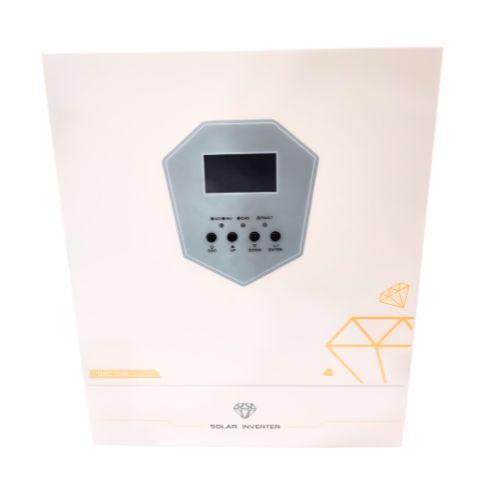
HYBRID INVERTER (T/F - QD3624SMH) 3.6KW
Key Feature
• QD3624SMH Hybrid Platform - Combines battery, solar and AC-source management in a dedicated hybrid inverter architecture.
• 3.6 kW Power Class - Provides the stated inverter capacity for residential, commercial and energy-storage AC loads.
• 24V class Battery Architecture - Uses the corresponding DC battery-voltage class for the inverter power stage and charging system.
• MPPT Solar Charging - QD3624SMH integrates MPPT photovoltaic charging for controlled solar-energy conversion.
• Hybrid Backup Integration - Suited to solar storage, off-grid backup and inverter-battery systems built around the QD3624SMH platform.
₹15,649.00
T/F QD3624SMH 3.6 kW Hybrid Inverter
The T/F QD3624SMH 3.6 kW Hybrid Inverter is a 3.6 kW hybrid solar inverter built for battery-backed AC power systems. It combines inverter power conversion with solar and utility-source management, using a 24V class battery platform. The reviewed model family includes MPPT solar charging for photovoltaic energy conversion.
Hybrid operation allows the inverter to work as the control point between PV generation, the battery bank, incoming utility or generator power and the connected AC load. The 3.6 kW rating defines the inverter power class, while the battery-voltage class determines the DC system architecture. These two values need to be designed together because higher AC output produces substantial battery-side current at low DC voltage.
The QD3624SMH product is described as a single-phase platform for 24V lithium or lead-acid battery systems with solar, grid and battery operation. Its solar controller manages PV charging inside the inverter, reducing the need for a separate charge controller in a correctly designed installation.
One point buyers often misunderstand is the difference between inverter power and battery energy. Kilowatts describe the rate at which AC power can be delivered, while kilowatt-hours describe how long the battery can sustain a load. A large inverter connected to a small battery does not create long backup time, and a large battery does not allow a smaller inverter to exceed its continuous power capability.
Source priorities and charging behaviour form part of the system design. PV array voltage must remain within the solar input window, battery charging settings must suit the connected battery technology, and AC loads need to remain within the inverter output envelope. Motor, compressor and pump loads also create starting demand above their running power, so load planning should account for both continuous consumption and short-duration surge behaviour.
Applications
• Home backup systems supplying lighting, fans, networking and selected household loads.
• Solar energy-storage installations combining photovoltaic input, battery storage and AC loads.
• Small-office and commercial backup systems requiring automatic transition between available energy sources.
• Off-grid and weak-grid sites where battery storage supports continuous AC power availability.
• CCTV, telecom, networking and control equipment requiring stable inverter-backed power.
• Custom ESS and inverter-battery projects built around the stated power and battery-voltage class.
Installation Guide
Have a competent installer isolate all AC, battery and PV sources before wiring or accessory installation. Mount the equipment with the ventilation clearances required by the system, route battery and solar conductors away from sharp edges, and use cables, terminals and protective devices sized for the actual current. Establish polarity and source separation before energising any DC connection.
Commission the system progressively. Establish battery voltage and polarity, apply the required inverter settings, energise one source at a time and observe the display or monitoring data before connecting the full load. Test normal source transfer and charging behaviour with a controlled load rather than beginning at maximum demand. Stop commissioning if wiring heats, protection trips repeatedly or the system reports unstable electrical values.
Record the inverter model, battery settings, source priorities, cable sizes and commissioning measurements with the installation. Keep ventilation paths clean and inspect high-current terminals during service for heat marks or looseness. Changes to battery type, PV array, connected loads or parallel architecture require renewed engineering review because earlier settings may no longer suit the revised system.
Why Choose ARB Accessories?
ARB Accessories supplies hybrid inverters and monitoring accessories alongside lithium battery packs, BMS products, solar components, ESS connectors, high-current cable, fuses and battery hardware for Indian system builders. Prepare your enquiry with the QD3624SMH model, 3.6 kW power class, 24V class battery system, PV array parameters and connected-load profile so the inverter or accessory can be matched to the complete electrical architecture rather than selected from power rating alone. System performance also depends on conductor sizing, protective devices, ventilation and battery capability, because an inverter can only deliver its intended output when the surrounding electrical path is designed for the same power level.
Product overview
T/F QD3624SMH 3.6 kW Hybrid Inverter The T/F QD3624SMH 3.6 kW Hybrid Inverter is a 3.6 kW hybrid solar inverter built for battery-backed AC power systems.
- SKU
- 26001367
- Category
- HYBRID INVERTER
- Unit
- PCS
- Minimum order
- 1 PCS
- Availability
- In Stock
Review key features and technical specifications before ordering. Contact ARB Accessories if you need compatibility or bulk-order guidance.