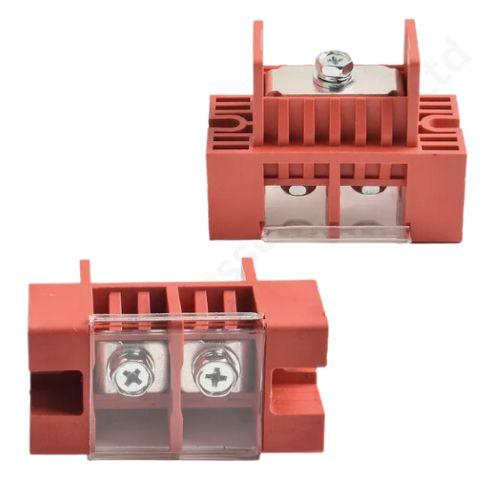
FENCE TERMINAL 100A 1IN-2OUT RED
Key Feature
• 100A Fence Terminal - Built as a high-current ESS distribution terminal for structured battery and inverter DC power routing.
• 1IN-2OUT Distribution Layout - Provides the stated input and output arrangement for organised branch connections inside energy-storage cabinets.
• Low-Resistance Joint Architecture - Designed around secure cable-lug contact and stable fastening for controlled heat generation at high current.
• Red Insulated Housing - Supports clear circuit identification and physical separation around the conductive terminal connection.
• ESS Cabinet Integration - Suited to lithium battery, solar storage, UPS and inverter assemblies using the matching distribution layout.
₹95.00
Fence Terminal 100A 1IN-2OUT Red
The Fence Terminal 100A 1IN-2OUT Red is a 100A fence terminal block with a 1IN-2OUT layout and red housing for structured DC distribution in energy-storage and battery systems. It creates a defined power-transfer point between battery conductors, inverter cabling and the surrounding cabinet architecture while providing an insulated housing for organised service access.
High-current ESS connectors sit between flexible cabling and the fixed electrical architecture of the battery cabinet. The defining selection rule is the fence-terminal geometry, current class, conductor arrangement and enclosure layout. A current label describes the connector family; it does not turn smaller cable, weak crimps or undersized protection hardware into a system of the same rating.
Electrical performance is dominated by contact quality. Flat mating surfaces, properly crimped cable lugs or contacts and stable mechanical engagement keep resistance low and help prevent local heating. The housing separates the conductive connection from the surrounding panel and gives the installer a defined mounting or mating point. Cable bend radius and strain relief should be planned so the joint carries current rather than cable weight.
High-current DC joints deserve the same attention as cells and busbars because a small resistance at a connector can create significant heat. Surface contamination, loose hardware, incomplete engagement and repeated thermal cycling all increase resistance. The practical engineering measure is temperature rise under the real duty cycle together with inspection for discolouration, softened insulation or movement. A sound connector cannot compensate for poor cable sizing upstream.
Colour and housing form help technicians identify circuits quickly, but polarity comes from the engineered wiring. Use consistent positive and negative conventions across the battery, breaker, inverter and service points. Keep conductors supported close to the connection so vibration and cable weight are not transferred into the joint. This creates a serviceable high-current interface that remains easy to trace inside an ESS cabinet.
Applications
• ESS cabinet power distribution between a main feed and downstream circuits.
• Solar battery storage systems using organised high-current branch connections.
• Inverter battery assemblies with fixed distribution points inside the enclosure.
• UPS and backup-power cabinets requiring structured battery-side DC routing.
• Battery test benches and service fixtures with repeatable high-current terminal points.
• Custom lithium battery enclosures using the same input and output terminal arrangement.
Installation Guide
Isolate the battery and inverter before fitting the connector or terminal. Prepare the mounting surface and cable routing, use terminations matched to the conductor and connection hardware, and protect exposed battery points throughout assembly. Support the cable close to the connection so the joint is not used as a mechanical anchor.
Commission the circuit with controlled energisation. Establish polarity and pack voltage before the final live connection, then apply load progressively while observing the connector, cable and protective devices. Investigate unexpected temperature rise, odour, discolouration or voltage drop rather than continuing operation with a stressed connection.
Record connector family, current class, cable size and fastening or mating arrangement with the cabinet build. Re-inspect joints after initial thermal cycling and during maintenance, especially in systems exposed to vibration or repeated service access. Changes to cable cross-section, inverter power or enclosure layout require renewed review of the complete current path.
Why Choose ARB Accessories?
ARB Accessories supplies ESS connectors alongside battery cells, BMS boards, busbars, cable lugs, silicone wire, fuses, breakers and enclosures for Indian pack builders and service teams. Prepare your enquiry with the required current class, connector family, colour convention, cable cross-section and mounting or mating arrangement so the power interface fits the planned assembly. A well-designed power path also keeps high-current joints accessible for inspection, because early signs of heating or loosening are easier to correct before they affect the enclosure. Cable support, enclosure layout and service access matter alongside electrical rating, since repeated movement can increase mechanical stress at an otherwise sound connection. For production builds, consistent hardware, tightening practice and labelled polarity reduce assembly variation and make maintenance faster across multiple battery cabinets.
Product overview
Fence Terminal 100A 1IN-2OUT Red The Fence Terminal 100A 1IN-2OUT Red is a 100A fence terminal block with a 1IN-2OUT layout and red housing for structured DC distribution in energy-storage and battery systems.
- SKU
- 26001058
- Category
- ESS CONNECTOR
- Unit
- PCS
- Minimum order
- 5 PCSs
- Availability
- In Stock
Review key features and technical specifications before ordering. Contact ARB Accessories if you need compatibility or bulk-order guidance.
Datasheet
Datasheet