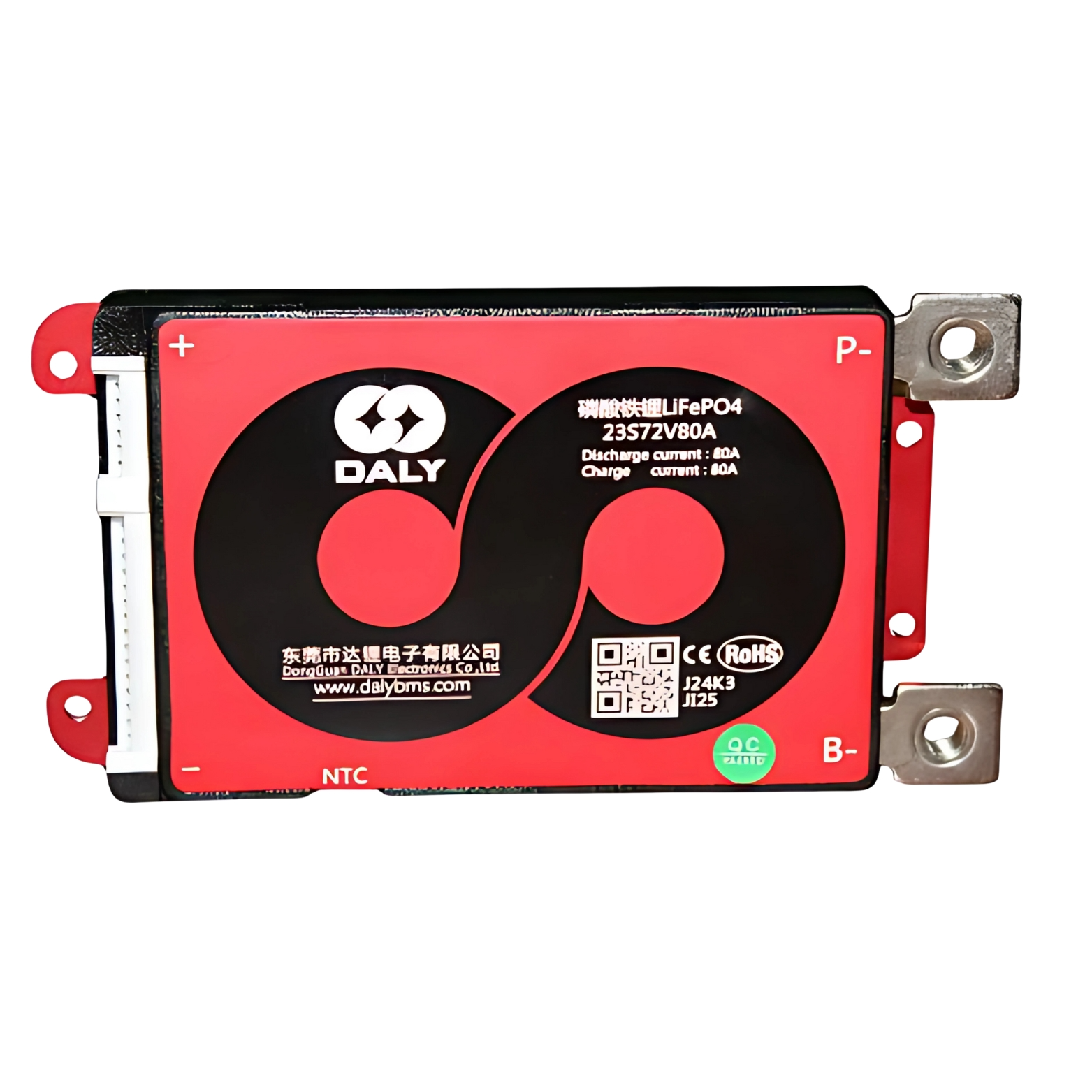
Key Feature
• 23S LiFePO4 BMS - Designed for twenty-three series LFP battery groups.
• 80A Current Class - Suits compatible medium-to-high current battery systems.
• DALY Hardware BMS - Dedicated battery-protection architecture for lithium pack integration.
• 73.6V Nominal Pack Class - Typical nominal voltage of a 23S LiFePO4 configuration.
• EV & Solar Storage Use - Relevant to mobility, inverter and stationary battery projects.
₹1,996.00
DALY BMS LFP 23S 80A
The DALY BMS LFP 23S 80A is a 23S LiFePO4 (LFP) battery management system in the 80A current class, developed for lithium battery packs where cell protection, current control and pack-level safety are central to system reliability. For buyers researching DALY 23S 80A LiFePO4 BMS, 23S LFP BMS, 73.6V battery BMS, 80A battery protection board, this product fits the common search intent around EV battery BMS, inverter battery protection, lithium battery management and high-current battery-pack control. A 23S LFP pack is commonly a 73.6V nominal battery architecture. The BMS is therefore most relevant when the battery chemistry, series count and operating current are already defined in the pack design.
A BMS sits between the cell stack and the external load/charger path. It monitors electrical conditions and disconnects or limits operation when the configured protection logic detects abnormal voltage, current or temperature conditions. Cell balancing helps control voltage drift between series groups, but it does not replace proper cell matching and pack assembly practice. In practical pack building, the BMS works as one part of a complete electrical system that also includes correctly matched cells, busbars or nickel links, cable, connectors, fusing, charger settings and enclosure insulation.
The key engineering parameters for this DALY BMS are the 23S configuration, LiFePO4 (LFP) chemistry and 80A current class. Series count determines how many cell groups the voltage-sense harness must supervise, while the current rating must be assessed against real continuous load, startup surge, cable resistance and thermal conditions inside the enclosure. At higher current levels, conductor cross-section, terminal quality, crimp or weld resistance and heat dissipation become increasingly important because even small connection losses can create localized heating. The charge/discharge wiring should follow the exact terminal layout supplied with the board.
The charger must use a voltage profile suitable for the selected chemistry and cell count. A charger intended for another lithium chemistry can push the pack outside the BMS operating window even when the nominal pack voltage appears similar. Motor controllers and inverters can also draw short surge currents, so size the system for the real duty cycle rather than the printed current number alone.
Select this BMS only after matching five items: LiFePO4 (LFP) chemistry, 23S series configuration, required continuous/peak current, charge-path requirement and physical/wiring compatibility. For replacement or new-build work, compare sense-wire order, main terminals, port design, controller or inverter demand, charger profile and cable size before installation.
High-current battery protection boards should also be mounted so the housing and cables are mechanically supported, protected from conductive debris and given appropriate space for heat to dissipate. Do not select a higher current BMS as a substitute for undersized wire, weak terminals or insufficient pack fusing; each part of the power path must be rated for the intended load.
Applications
• Electric vehicle and e-scooter battery packs.
• Solar inverter and off-grid lithium battery systems.
• Stationary energy-storage and backup battery packs.
• Battery repair, refurbishment and BMS replacement work.
• Custom lithium battery projects for OEM and workshop assembly.
Installation Guide
Isolate the battery pack from the charger and load before installation. Verify every series-group voltage with a suitable meter, confirm polarity, and connect the sense harness in the sequence specified for the BMS rather than guessing from wire colour. Secure the main current connections with low-resistance joints and provide strain relief so cable movement does not load the BMS terminals. Keep exposed conductors insulated from the enclosure and from adjacent busbars. After wiring, commission the pack with a controlled charge/discharge check and monitor voltage behaviour and temperature before applying the full intended load.
Why Choose ARB Accessories?
ARB Accessories focuses on lithium-battery, EV, energy-storage and battery-pack assembly components. The catalog brings together BMS boards, connectors, insulation materials, battery wiring, terminals, fuses, enclosures, testing equipment and assembly tools. For battery builders, repair workshops and OEM buyers, sourcing related components from one specialist catalog can make specification matching and procurement easier. Final suitability should still be checked against the exact battery design, equipment model and electrical requirements before installation.
Product overview
DALY BMS LFP 23S 80A The DALY BMS LFP 23S 80A is a 23S LiFePO4 (LFP) battery management system in the 80A current class, developed for lithium battery packs where cell protection, current control and pack-level safety are central to system reliability.
- SKU
- 26000169
- Category
- BMS LFP
- Brand
- Daly
- Unit
- PCS
- Minimum order
- 1 PCS
- Availability
- In Stock
Review key features and technical specifications before ordering. Contact ARB Accessories if you need compatibility or bulk-order guidance.